If you run an indie SaaS or cross-border site, checking Ahrefs or Google Search Console every week is probably second nature.
Recently, our official site netconfiger.com caught a bizarre metric spike in our Ahrefs dashboard. Our Overview panel suddenly lit up with some crazy numbers:
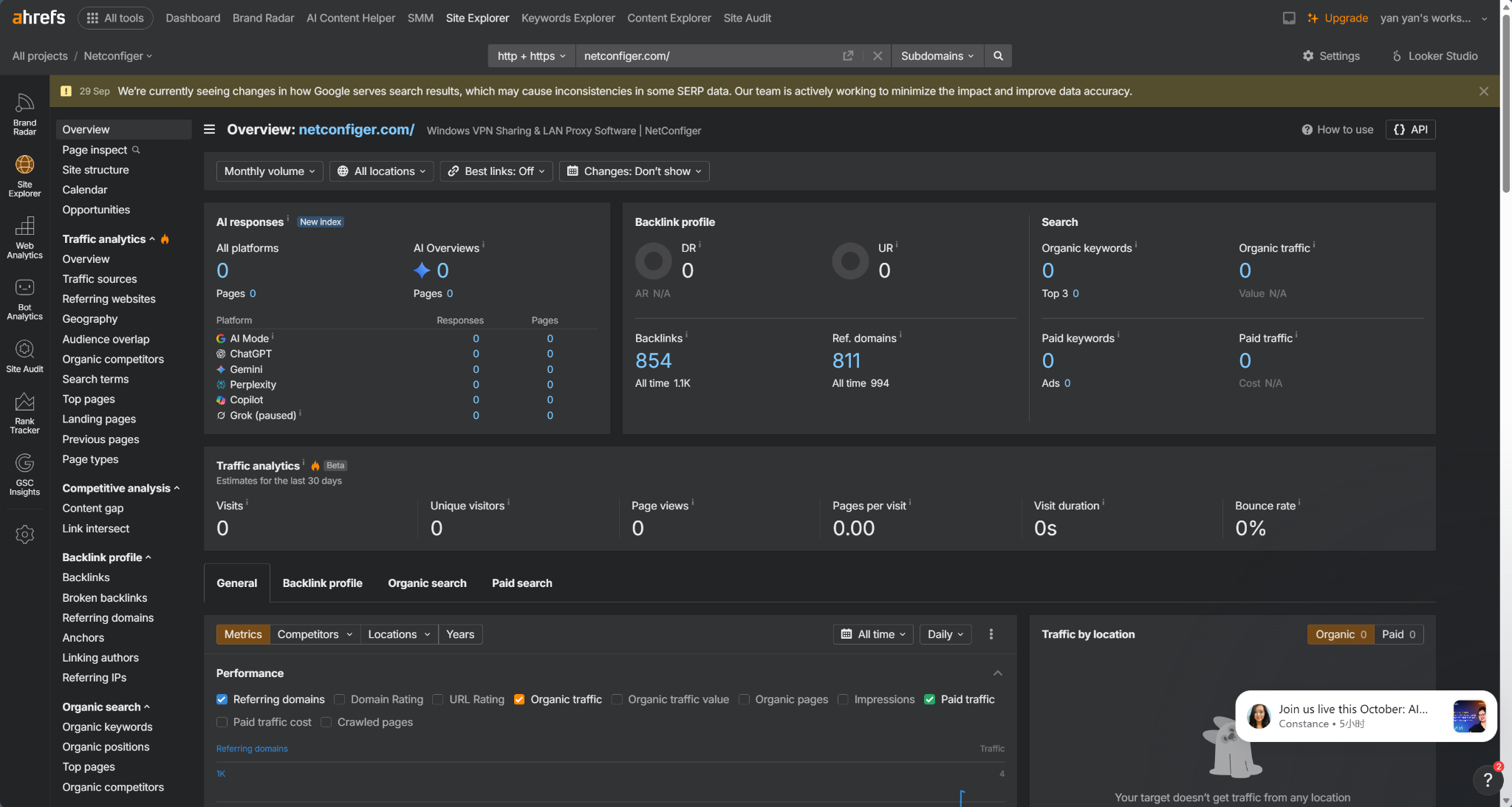
| Metric | Value | Status & Notes |
|---|---|---|
| Backlinks | 854 | Sudden short-term spike (1.1K All-time) |
| Ref. domains | 811 | Overnight flood of new domains (994 All-time) |
| Domain Rating (DR) | 0 | No actual link juice passed |
| Organic Traffic | 0 | Spam PBN network carrying zero real search traffic |
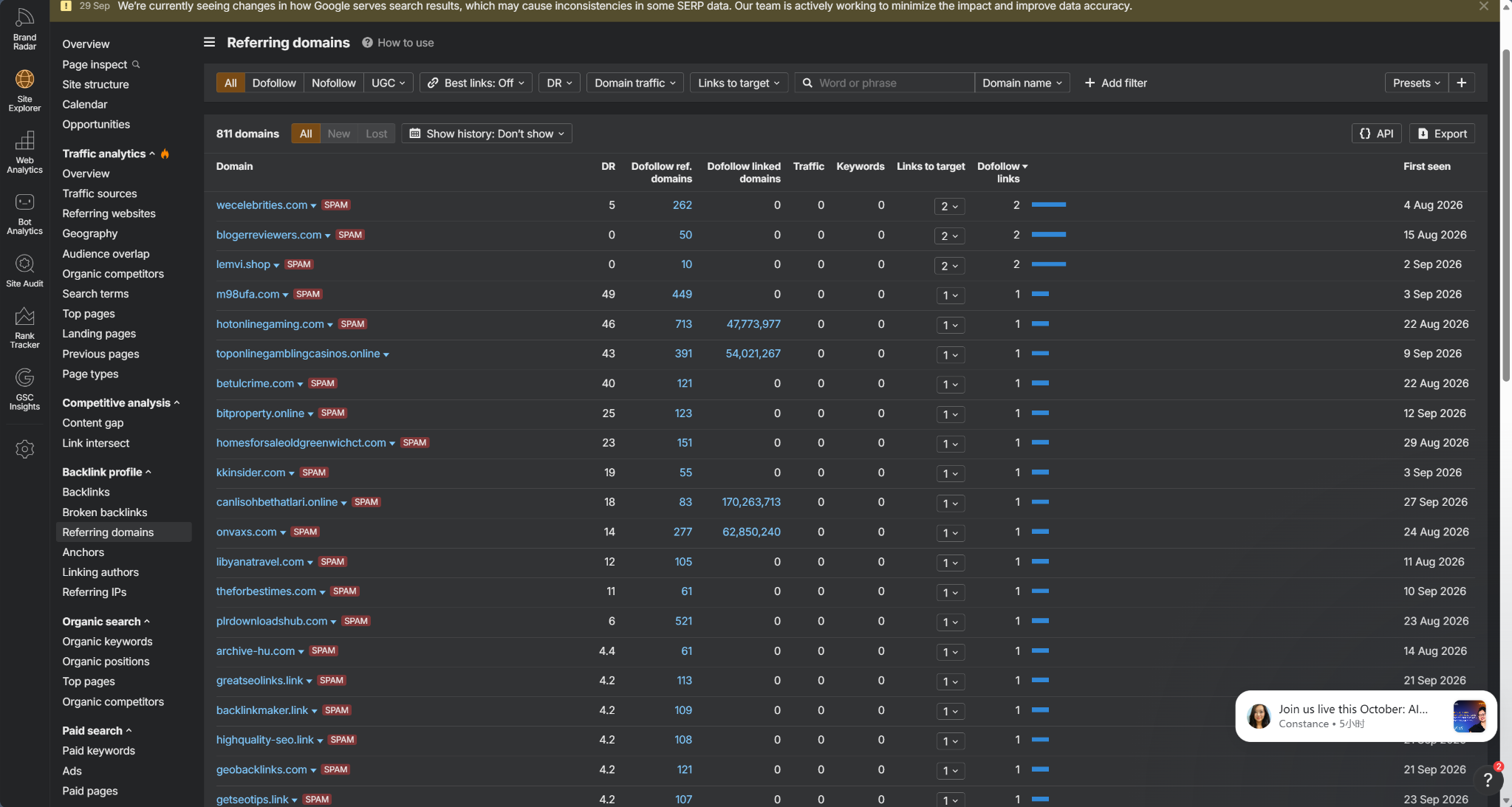
At first glance, you might wonder if one of your products got featured on a major tech outlet. But once you dig into the "Referring domains" and "Backlinks" tabs, reality hits: almost every single domain carries a bright red SPAM badge from Ahrefs.
1. Dissecting the Raw Data: What Do These Spam Domains Look Like?
A. Representative Spam Domains Sample
Here is a snapshot of the domains extracted directly from our Ahrefs crawl report:
| Referring Domain | SPAM Flag | DR | Target Dofollow Links | First Seen Date |
|---|---|---|---|---|
wecelebrities.com |
SPAM | 5 | 2 | Aug 4, 2026 |
bloggerreviewers.com |
SPAM | 0 | 2 | Aug 15, 2026 |
m98ufa.com |
SPAM | 49 | 1 | Sep 3, 2026 |
hotonlinegaming.com |
SPAM | 46 | 1 | Aug 22, 2026 |
toponlinegamblingcasinos.online |
SPAM | 43 | 1 | Sep 9, 2026 |
greatseolinks.link |
SPAM | 4.2 | 1 | Sep 21, 2026 |
backlinkmaker.link |
SPAM | 4.2 | 1 | Sep 21, 2026 |
highquality-seo.link |
SPAM | 4.2 | 1 | Sep 21, 2026 |
B. Technical Teardown of the Backlink Templates
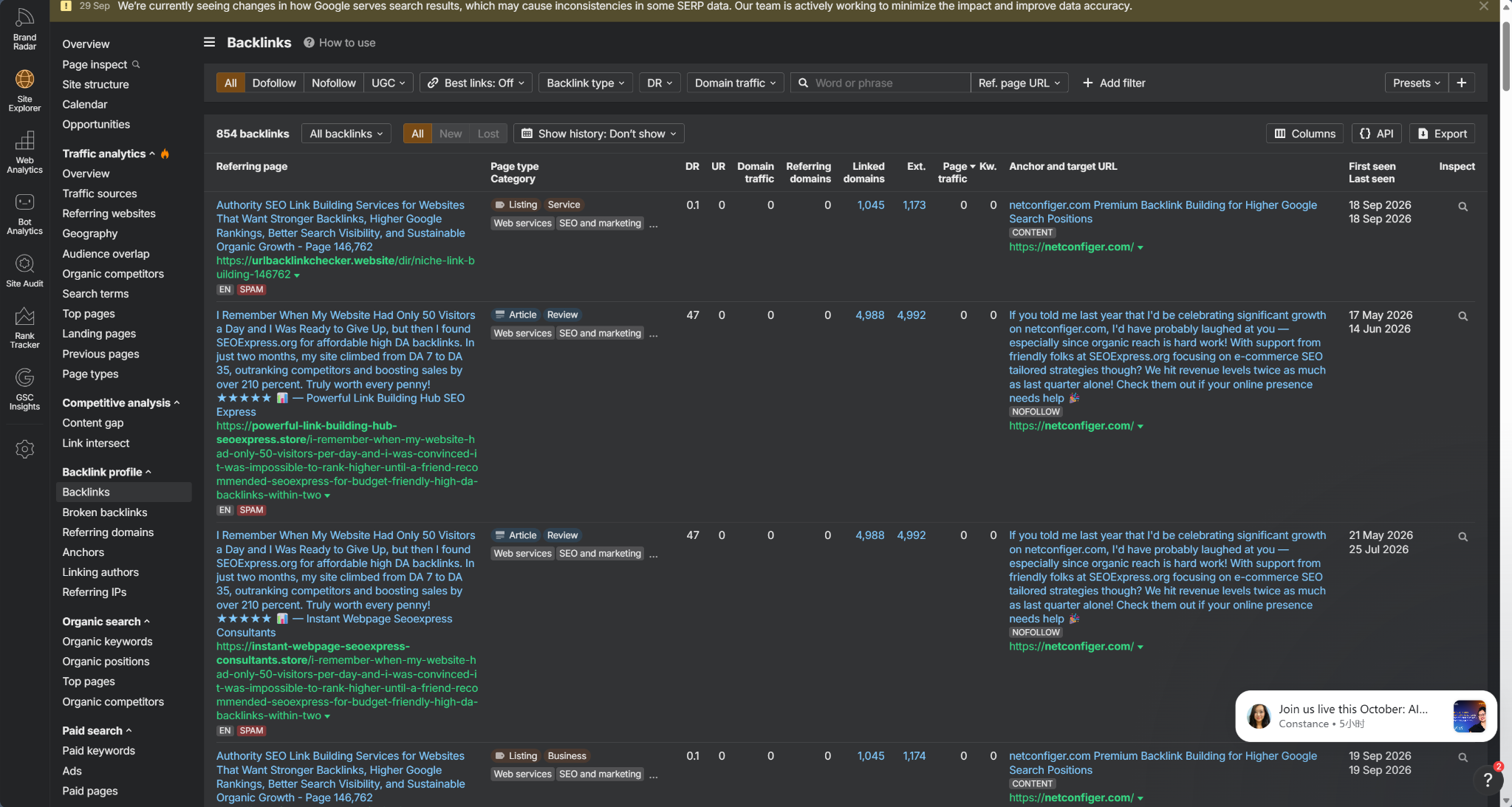
When you inspect the underlying HTML of these 854 backlinks, you quickly realize they are auto-generated via scripts using two distinct templates:
| Pattern Type | Sample Referring URL | Injected Anchor & Context | Link Attribute |
|---|---|---|---|
| Type A: Parameterized Directories | urlbacklinkchecker.website/dir/niche-link-building-146762 |
netconfiger.com Premium Backlink Building for Higher Google Search Positions |
CONTENT |
| Type B: AI-Generated Review Stories | powerful-link-building-hub-seoexpress.store/i-remember-when... |
"I remember when my website had only 50 visitors... until I found SEOExpress.org... growth on netconfiger.com..." | NOFOLLOW |
| Type C: Pseudo-DA Tools | dacheckerseo.website/dir/niche-link-building-146762 |
netconfiger.com Premium Backlink Building for Higher Google Search Positions |
CONTENT |
What Are They Actually Trying to Achieve?
This entire operation isn't designed to rank your site or boost your authority. They are piggybacking on Ahrefs' crawler to pull off targeted redirection hijacking:
- Triggering Alerts: AhrefsBot picks up these fake pages and sends backlink alert emails to webmasters;
- Redirect Hijacking: When a curious site owner clicks the link in Ahrefs to investigate, client-side JS or 301/302 redirects forcibly bounce them straight to a commercial SEO sales landing page.
2. How Should Site Owners Handle This?
Staring at hundreds of SPAM flags can be intimidating, but here is the sensible way to handle it:
- Don't hit the panic button (and don't pay for removal)
Google's SpamBrain algorithm is smart enough to identify and ignore automated PBN link floods. These links pass zero equity and won't trigger direct algorithmic penalties. - Go easy on the Disavow Tool
Unless you receive an explicit Manual Action in Google Search Console, you don't need to throw hundreds of spam domains into a Disavow file. Over-disavowing can sometimes do more harm than good to your natural link graph. - Don't fall for metric anxiety
The spammers rely on your data anxiety to get sales. Once you see through the trick, ignore the noise and keep building great products.
3. From SEO Audits to Facebook Ad Account Isolation
Inspecting weird redirects and managing cross-border marketing channels often require site owners to deal with complex local network topologies.
If you run a cross-border site, Google SEO is only half the battle—Facebook and Instagram ad campaigns are where the real revenue happens. But Meta platforms are notoriously brutal when it comes to environment flags, IP hygiene, and network isolation. One mismatched network footprint can get your entire ad agency matrix banned.
For a multi-device team workflow, you usually need:
- Workflow Isolation: One rig running automated scrapers and inspecting backlink logs, while a separate workstation or VM handles active Facebook Ad accounts.
- Network Adapter Routing: Forcing specific VMs or browsers to bind to dedicated physical NICs, virtual adapters, or residential proxy gateways (HTTP/SOCKS5).
- Strict Anti-Association: Ensuring complete separation at the underlying network layer so Meta never links your testing setups with your primary business accounts.
Swapping settings inside a browser isn't enough when managing multiple Windows machines. For our team's multi-device setups, we rely on NetConfiger to handle local network routing directly across dedicated physical or virtual adapters—keeping our FB ad environments completely isolated from diagnostic work.
Bottom Line
Don't let temporary noise in third-party SEO tools dictate your daily operations. When you see 800+ spam referring domains pop up in Ahrefs, understand the technical reality, skip the unnecessary disavow stress, and keep your focus on product quality and a robust multi-environment network infrastructure.
Key points
- Massive spam referring domain spikes in Ahrefs are automated redirection schemes designed to target webmasters inspecting their backlink reports.
- Google's SpamBrain algorithm automatically neutralizes low-quality PBN backlinks, making panic or paid removal services unnecessary.
- Cross-border site management and Facebook ad matrices require strict local network isolation across multiple physical or virtual network adapters using NetConfiger.